






Wind energy has become one of the leading producers in renewable energy. There will always be a demand for energy, so being able to extract clean renewable energy has become very important for the public and the surrounding communities.
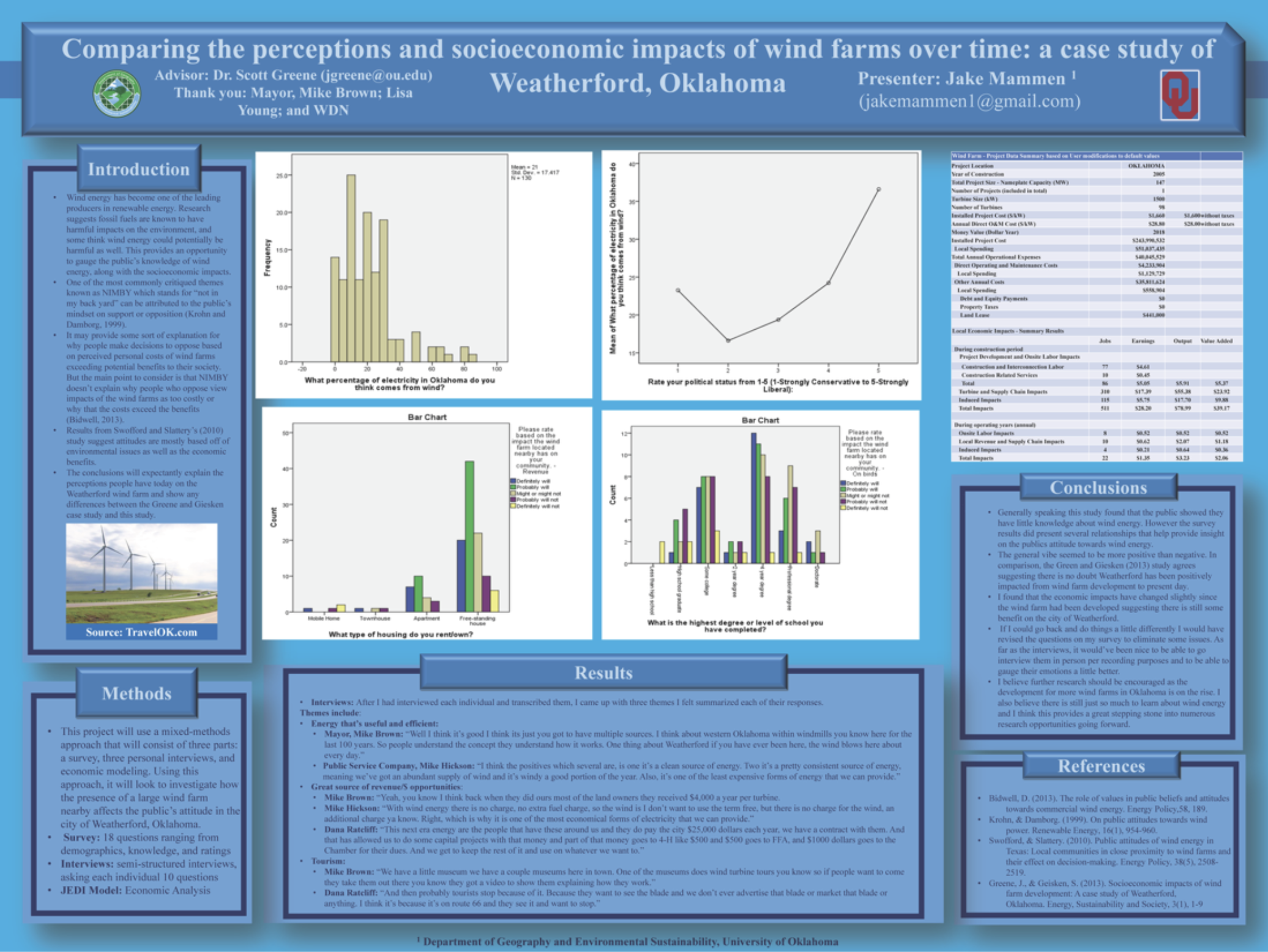
Research suggests fossil fuels are known to have harmful impacts on the environment, and many may attribute wind energy to be a contributor to that as well. This provided an opportunity to gauge the public’s knowledge of wind energy, along with the socioeconomic impacts. There have been several other studies that focus more on the economic or social aspects of wind farm development. This particular study, however, examined the perceptions over time and compared those perceptions to the research found in the Greene and Giesken (2013) case study about the perceptions and socioeconomic impacts of wind farm development in Weatherford, Oklahoma.
This study analyzed the combined and varied perceptions associated with wind power, as well as the socioeconomic impacts in the same location (Weatherford, OK). Additionally, this study used a mixed-methods approach to investigate the perceptions people have in Weatherford, Oklahoma, with a large wind farm nearby. This approach consisted of three components: a survey, semi-structured interviews, and economic modeling. The economic modeling will be completed to determine both direct and indirect economic impacts.
Results from this research shows the comparisons between economic impacts on the local community and the differences in perceptions over approximately the last 12 years. In addition, the interviews and surveys illustrate and describe the overall attitudes of the population towards the wind farm compared to when it was being developed. The conclusions expectantly highlighted any differences between the Greene and Giesken (2013) case study. Research like this is very important in order to fully understand the impacts wind farms have on the local community and how those impacts may change over time.
The overall goal of this research was to assess and compare the perceptions and socioeconomic impacts from the development of the Weatherford Wind Farm to when it was fully developed. The survey and interview results provide a reasonably good idea of how people perceive the wind farm in Weatherford, Oklahoma. The general vibe seemed to be more positive than negative as a result of my findings.
As for the public, there may not be a complete understanding of wind energy; However, there is still the potential for a fairly strong understanding to be obtained in which the positive impacts from the wind farm outweigh the negative impacts. In comparison, the Greene and Giesken (2013) study agreed with this study stating there is no doubt Weatherford has been positively impacted by the wind farm from when it was being devloped.
This study turned out to be fairly successful due to the availability of data and ability to conduct informational interviews.
I believe further research should be encouraged as the development of more wind farms not only in Oklahoma, but many states across the country, is on the rise. It would be interesting to see if other communities were to ever push for wind farm development after seeing the benefits other communities have received. I believe there is still just so much to learn about wind energy, and I think this provides a great stepping stone into numerous research opportunities going forward.